Monday, October 27, 2014

Flying Paper

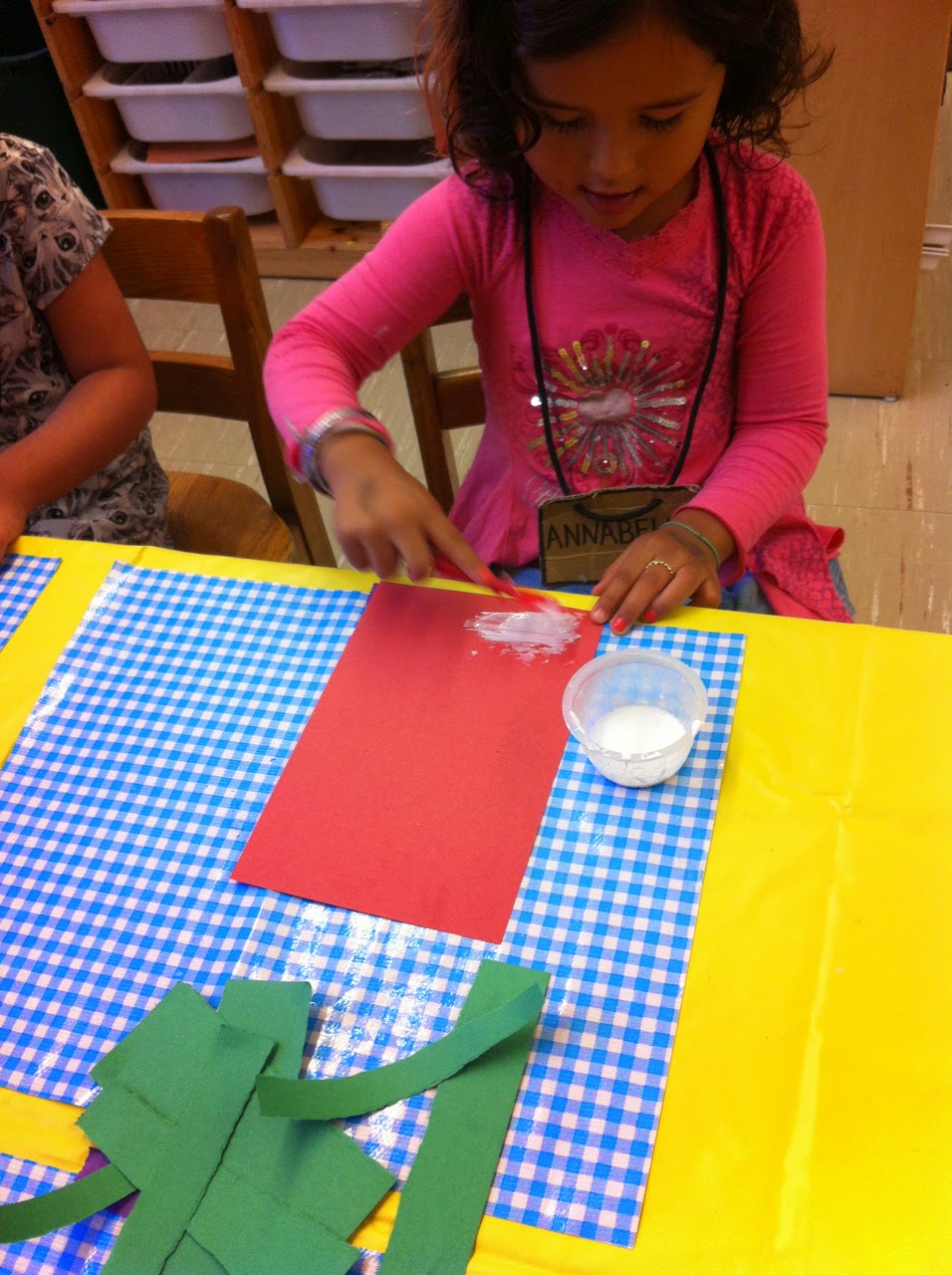
Between forms to be filled, reams to be gathered, dismissal notes, and backpacks full of pencil-outlined sad-missing-mommy-faces and/or I'm-a-big-boy-now rainbows, the beginning of the school year always generates an abundance of paper. In the BNS hallways paper is flying! What seems to be a math project focused on abundance and cumulation and comprised of graph paper cut into ten 100-square sections has culminated in a sculptural installation of that waves to excited children hurrying by! 


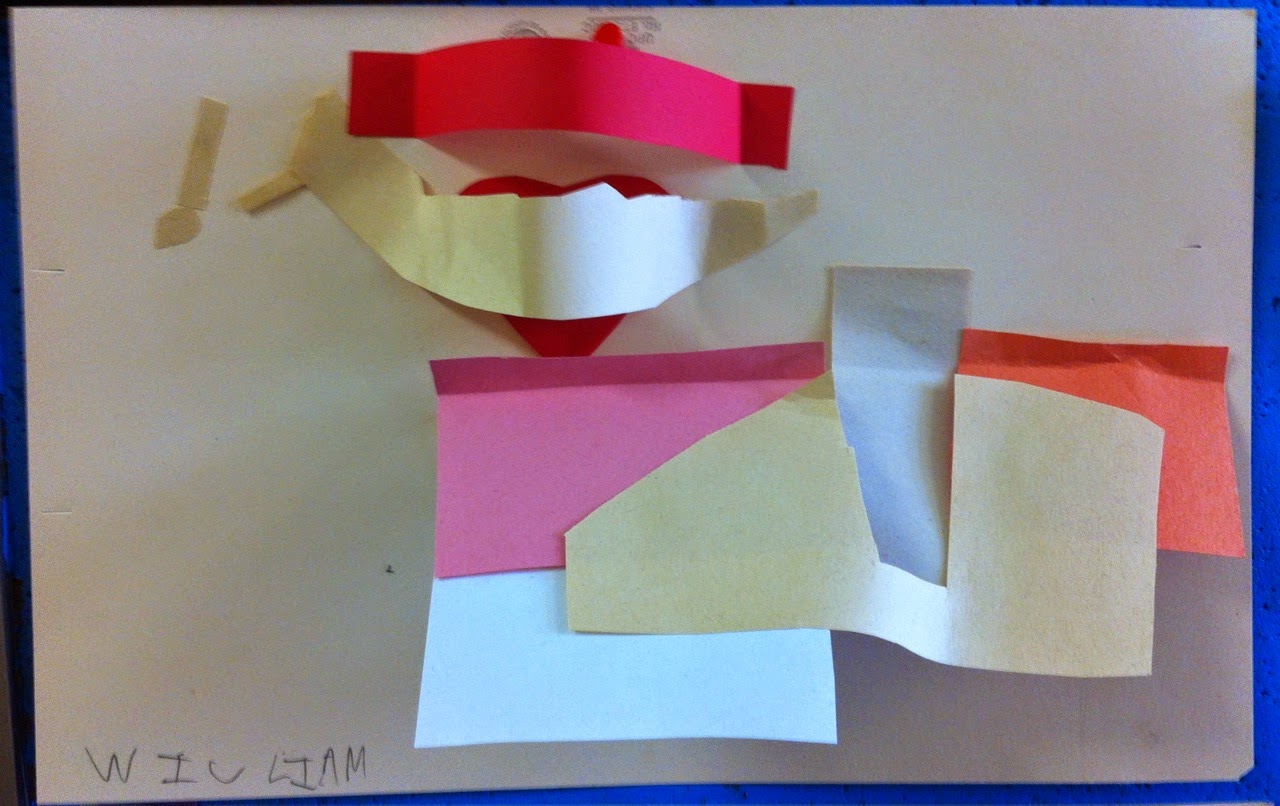
Meanwhile, more discreet investigations ensue: Pre-k kids explore contrasting colors through tearing paper and gluing curled pieces down; first graders' collages jump and tease as they cut, fold and play with volume. 


Tuesday, June 24, 2014

Great Small Works at Ecorama: "Sandy, Sandy, Sandy"

Great Small Works is a local theater troupe that works in equal parts to delight audiences with drama and puppetry and to provoke them with thoughtful, edgy commentary about current events. At Ecorama, for the 4th and 5th grade, GSW transformed room 323 into a spooky underwater enclave complete with mini enclaves (fishtanks) used for the puppet play. Therein was told the tale of Coral (sea coral), Salty (a 400 year old pirate) and Lucia (a blue heron) struggling to manage life's challenges post hurricane Sandy.


The "rich people" puppets who employed private fire fighters. The one on the left is about to lose his head!
For every class, the fact that one of the puppet's heads came off fascinated the children. Roberto Rossi aka "Coral" explained that a few days before the show, the puppet broke! Ack, what to do?? He decided to work with this new, two part iteration of the puppet and weave a decapitation into the play. So resourceful!


Following the performance, students asked the troupe many excellent questions: How old is Salty? And why is "Salty" his name? How did you create your costumes? How did you create the characters? Is that your real hair? Where were you during the hurricane? What are you doing about climate change? (Wise kids we have). When and where can we see more GSW puppet plays? (Click here to find out more about GSW's where and when-abouts). As much as GSW put out for our kids, our kids in turn put out for them with their knowledge and bold curiosity. 


Thank you, GSW, for your wisdom, ingenuity, humor and hard work!
Meredith Holch as Blue Heron
Roberto Rossi as Coral
And, thank you, Barbara and Johanna for facilitating the event's production in conjunction with Ecorama, Mia for videotaping the whole thing from every angle possible, Justin Weiner for his awesome photography, and all the volunteers and teachers who participated.

The final words of show and overall gist of the event in its entirety? Whether you are dealing with environmental destruction, political action, or making and producing puppet plays, success depends on working together. Viva!


Jenny Romaine and Salty

Honoring Ann Rosen

Are these the last days of school, or the first of Summer? With ceremonies and celebrations -- and watermelon – in the offing, we take a moment to honor and thank Ann Rosen, who has helped enrich the BNS community for almost two decades. A practicing artist and a devoted teacher, Ann inaugurated the school’s art department, and later the first floor art studio. And she worked with classroom and department teachers to integrate visual arts programming into their curricula at every grade level. Only a few recent examples: Beautifully re-imagined Gowanus landscapes, part of the 4th grade’s sustainability and social studies unit. 


The 1st grade’s bug study, happily infesting the halls of 610 Henry Street. 


Mayan masks with the 5th grade, the 3rd grade’s clay figures and bamboo drawings. The list goes on.


BNS prizes the arts as a vital component of learning, and Ann Rosen has worked steadfastly to nurture and celebrate opportunities for our kids to dig in with their hands and their hearts. A hearty kudos to you, Ann. And many thanks for your generosity, spirit and dedication!


Wednesday, June 11, 2014

Brown-Earthy and Rich Botanical Bas Relief. Beautiful!

In Paola's class the kids completed a year long botany study. They did planning drawings to scale of original plants with specific qualities. In response to all of the green spaces they visited this year they also created a series of planning/mappings sketches of their ideal green space. These were re-envisioned in a 3d model then built out of clay using a square base sculpture and bas relief.

These pieces were made of brown stoneware that was fired to cone six to get a rich color.


What does your ideal green space look like? If you send an image to bnsartalive@gmail.com, I'll post it!

Tuesday, June 3, 2014

Over and Under Everything!

Andrew's class has been exploring weaving all year in collaboration with Rachel S. First Rachel worked with students to learn the basic stitch: over, under, over, under. 


They worked with paper first then made a giant loom to crawl through to get the "over and under" feeling into their bodies. How cool is that? Then students experimented with the "over and under" stitch on varied surfaces: sticks, straws and fingers. 


They wondered, what else could be a loom?  Looking around the classroom, kids thought about weaving on radiators and book baskets and the fence around the playground: anything that could be a recipient for their strings, yarns, and ribbons. Seeing possibilities everywhere, we sought donations from the people at Philadelphia Salvage. A collection  of "recycled looms" grew to include tennis rackets, baby gates, old shutters, and pickle barrel hoops. The kids set to work preparing "weavers" from strips of fabric, ribbons, caution tape and yarn. One student, AJ, really enjoyed being a "fabric ripper," tearing bolts into many useable strips.


 Working with partners over the course of many weeks, the class discovered the potential for unexpected objects and materials to be transformed into color and texture-filled beauty of many sizes and shapes with nothing more than the "over and under" mantra guiding the way. 


What can you find that can be a loom? Thank you, Rachel, for giving our kids a chance to experiment with this process and for taking these wonderful photos. Bring on the over, under...

Tuesday, May 13, 2014

A Roving Parent and The Very Busy, Hungry, Lonely, Brown Bear, Brown Bear.


Great author/illustrator + great stories + great teachers=great art made by kids. 


Need more be said? Hooot.

Seen any great art in the hallways lately? Send a snap or two to bnsartalive@gmail and blog it!


Fourth Graders Reflect on the Algonquian Museum

In second, third, fourth grade and fifth grade we have "museums." In second grade we studied islands and had a museum that showed islands we made. Then we studied bridges and made bridges. In third grade we had the China and Africa museum and in fourth grade we study Native Americans. 

We learned about the Native Americans' daily activities, objects they used and how they survived by using only what they needed. We made wampum belts, clothing, weapons, baskets and games and lots of dioramas. Some dioramas have corn husk dolls.

-by Tallulah, Thalya and Gigi


Our museum was about the Algonquins, a group of native americans that roamed most of New York and beyond. Our museum
was about these peoples. Families and other classes visited.


We made dioramas, clothing and wampum belts. In order to make these things, it required months of study and weeks of coming up with ideas.
Our museum was fun and exciting. Many children and grown ups enjoyed our projects, which required a lot of creativity, learning and skill.
-by Anna


In the 4th grade we learned about the Algonquins. We learned about how  they made fishing nets, baskets, and how to throw a spear using a special tool called an "atl atl."

For our Algonquin Museum an event we hold every year we made many of these things during "project time." We have various materials available to us and parents and teachers help us make things. When we finish the projects we share them with the school and curious parents. Smaller children were led around with fourth grade "tour guides" who guided them through the museum. We shared colorful dioramas, interesting research essays and unique projects. 


We, the 4th graders, really enjoyed the museum. We had lots of fun seeing other peoples projects and collaborating with friends.

-by Talya, Vera, and Rose


This year's museum covered a range of topics: shelter, defense, daily life, seasons, and beliefs. Some of the projects we made for the Algonquin Museum were games, dioramas, weapons and clothing. It took 1 week and 2 days to build our projects. A few thoughts from our classmates after the museum:

"I felt like I accomplished something."

"I felt sad it was over."
"I felt proud."
-by Isaac and Supreme


The Algonquins are people who lived in New York a long time ago. They lived in homes called "wigwams" which they built themselves.

The Native American museum is when we teach people about Native Americans and share what we learned. Kids made dioramas of wigwams, games, toys and weapons. It was so fun and all the kids did a really good job. To me, it was the best museum yet.

-by Jordan


Before the museum happened, some people felt nervous and some were excited. We had project time for three weeks. On the last day everybody was working very hard to finish the last details of their projects. All the projects were beautiful. I think people were relieved when it was over. Some people were sad. 

This school is awesome because we do a lot of activities.

-by Tymani, Joscelyn, Kali and La-Nise


We studied the Native American of the Eastern Woodlands and then had a museum sharing our study. We researched parts of their culture and then converted what we learned into projects about farming, homes, and hunting.

To make our projects we had "project times" on certain days of the week. To make dioramas we used a board and various items to build our structures. We made spears, bows and arrows. 


All of this was really fun. In the beginning of the museum everyone was really nervous. Lots of people came. During the museum we were unhappy because we said the same thing over and over again and we were sad because making the projects was so fun. Otherwise it was awesome!

-by Marlen, Dexter, and Kaya


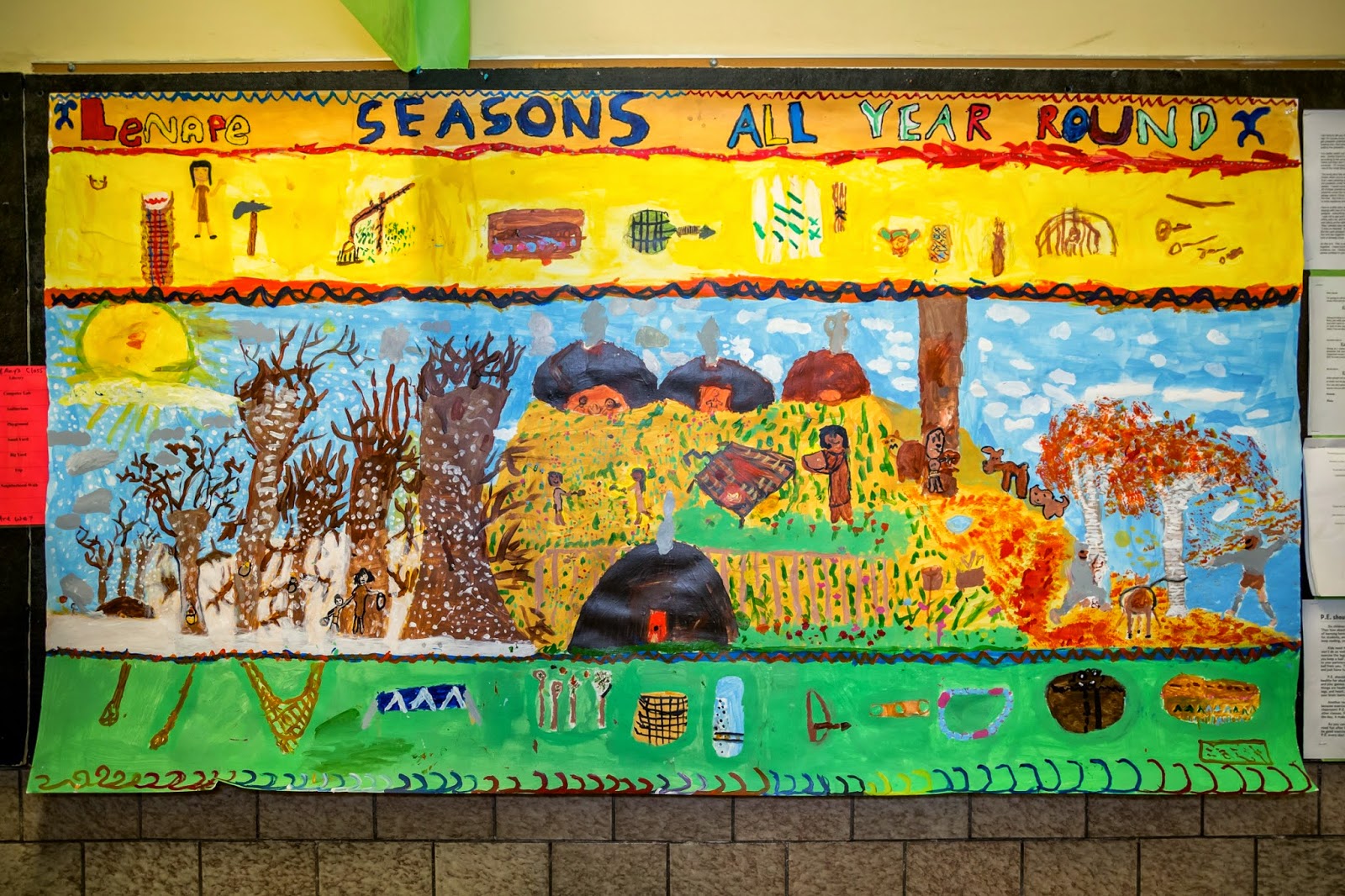
For our museum, some of us built a diorama showing how the Lenape people used to fish, hunt, make traps, farm and built homes called wigwams. Wigwams were made out of sticks and birch bark.

Some kids worked on storytelling explaining what Lenape beliefs were. Clothing was a big part of their culture. It was designed with beautiful beads and animal skins such as beaver, otter and deer skin.


During seasons they grew and ate different kinds of food. During winter and fall they would eat stew, corn and meat. Spring and summer they would grow and eat corn and strawberries.

-by Orion, Andrew, Will and Christian


What did you like about the Native American museum this year? Post a comment!


Photos courtesy of JustinWeiner (Dad to Tyler and Olivia)

To view Justin's full slideshow go here: http://tinyurl.com/bns-2013-ic
Feel free to download from gallery, share and/or re-host the images.  A simple photo credit is appreciated, where applicable (on blogs, in print, etc.)